

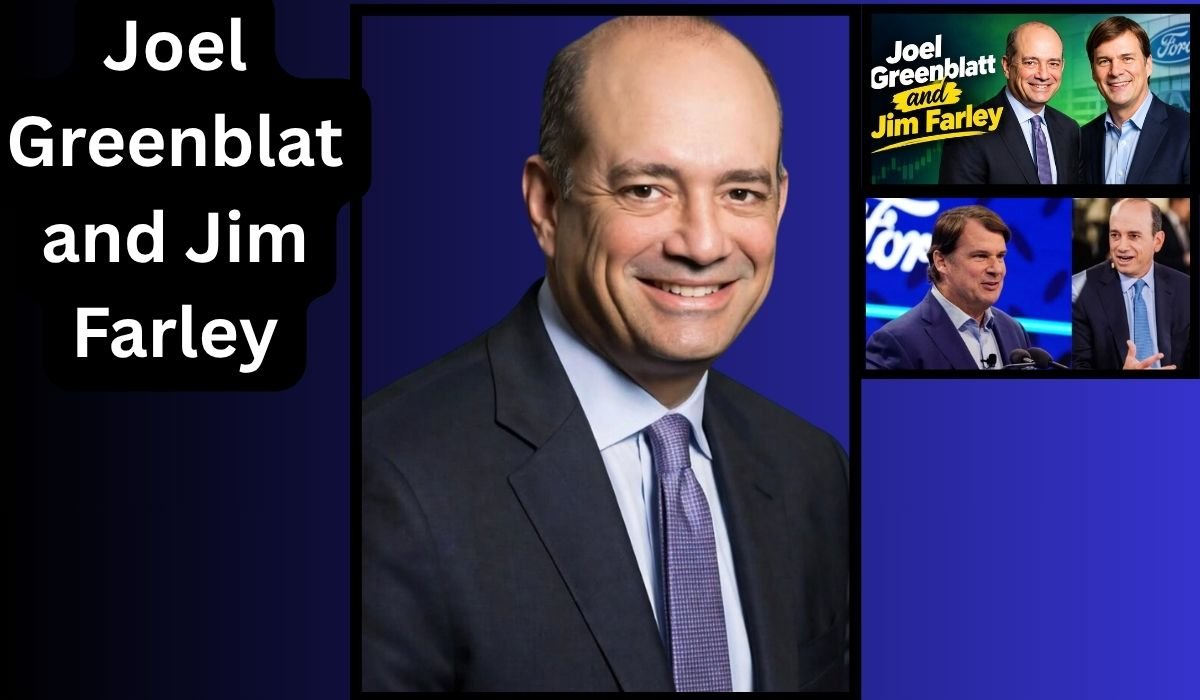
Joel Greenblatt and Jim Farley show up together in a lot of searches, yet they work in different worlds. One is an investor, author and co-chief investment officer. The other runs one of America’s best known carmakers. This short guide explains who each man is and how their jobs compare.
Jim Farley’s full name is James D. Farley Jr., and he leads Ford. Greenblatt manages money and teaches investing ideas. You’ll get their backgrounds, a side by side look at their work, and a few practical lessons. Nothing here is personal investment advice, so always check current filings before acting.
Who Are Joel Greenblatt and Jim Farley?
People compare them because both names appear in business news. The Joel Greenblatt Jim Farley difference is simple, though. One studies companies from the outside, and the other runs one from inside.
Greenblatt is a value investor and teacher. Farley is a long serving auto executive. Seeing them side by side clears up a lot of confusion. Each section below sticks to public facts.
- Greenblatt is an investor, teacher, and author of well known investing books.
- Farley has been the chief executive of Ford since October 2020.
- Both names connect to Ford in online searches, but not through any known partnership.
- The main split is easy to remember: one allocates capital, and the other runs a company.
Read More: David Zaslav And Conor McGregor: Is There A Link? Facts 2026
Who is Joel Greenblatt?
If you’re asking who is Joel Greenblatt, start with his reputation as a patient stock picker. Joel Greenblatt built a career on buying good companies at low prices, and he’s best known for Magic Formula investing.
He teaches, writes, and runs money, so his ideas reach both professionals and everyday readers. His approach rests on value investing, which simply means paying less for a business than it’s worth.
- He founded a respected investment firm and wrote books that sold widely.
- He has taught value ideas to students and readers for many years.
- He’s famous for a simple, rules based way of ranking stocks.
- He’s open about his methods, which makes them easy to study and test.
Building Gotham Capital
He started Gotham Capital in 1985 with Robert Goldstein, and the pair focused on special situation investing, such as spin offs and companies in restructuring. That work shaped how he hunts for mispriced stocks.
In 2009 he relaunched the business as Gotham Asset Management. The Joel Greenblatt Gotham role is managing principal and co-chief investment officer, and Goldstein works alongside him.
- Gotham Capital began as a small partnership in the mid 1980s.
- Goldstein joined him early and still works with him at the firm today.
- Special situations include spin offs, mergers, and businesses reorganizing after trouble.
- Today the firm runs rules based strategies that can hold a very large number of stocks.
Greenblatt as an Author and Educator
The Joel Greenblatt books reach a wide audience because they explain tough ideas in plain words. His investment philosophy shows up in every one: understand the business, then pay a fair price.
He also teaches as an adjunct professor at Columbia Business School, where he shares value ideas with students. That clear teaching style is a big reason his name is so familiar.
- You Can Be a Stock Market Genius came out in 1997 and explains how special situations can create bargains.
- The Little Book That Beats the Market arrived in 2005 and introduced his ranking method to ordinary readers.
- His 2011 book gives simple, practical advice for everyday savers.
- His writing avoids jargon and relies on short, memorable examples.
| Book | Year | Main idea |
|---|---|---|
| You Can Be a Stock Market Genius | 1997 | Finding mispriced stocks in special situations |
| The Little Book That Beats the Market | 2005 | Ranking stocks by quality and price |
| The Big Secret for the Small Investor | 2011 | Simple investing guidance for everyday savers |
What does his Magic Formula measure?
So, what is the Magic Formula? It’s a ranking system that scores companies on two things: how good the business is, and how cheap the stock looks.
Business quality uses return on capital, which compares operating profit with tangible capital such as working capital and fixed assets. Cheapness uses earnings yield, which compares operating profit with enterprise value.
- Both scores come from basic numbers found in a company’s financial statements.
- A higher quality score and a lower price both earn a better rank.
- Debt and cash matter, so the price score looks at the whole company, not just the shares.
- The two ranks get added together, and the lowest totals rise to the top of the list.
The Magic Formula Approach
Wondering how does the Magic Formula work? Think of a stock screener. You rank thousands of US-listed equities on both scores, add the two ranks, and study the best combined names.
That’s Magic Formula investing explained in short, with financial companies and utilities excluded because their numbers don’t compare well with other businesses. Then you buy a handful of top names and wait.
- The book suggests holding roughly 20 to 30 stocks to build a diversified portfolio.
- Each pick is usually held for about a year before you sell and repeat.
- The book’s backtest from 1988 to 2004 showed an average of 30.8% a year, against about 12.4% for the S&P 500. Those were hypothetical results.
- Backtests aren’t promises, and there’s no guarantee of investment success, especially over short periods.
| Step | What you do | Why it matters |
|---|---|---|
| 1 | Start with one clear group of stocks | Keeps the comparison fair |
| 2 | Remove banks, insurers, and utilities | Their numbers don’t compare well |
| 3 | Rank every company on business quality | Favors strong earners |
| 4 | Rank every company on price | Favors cheaper stocks |
| 5 | Add the ranks and buy top names | Blends quality and price |
| 6 | Hold about a year, then repeat | Gives the method time to work |
Who is Jim Farley?
If you’re wondering who is Jim Farley, he’s the president and chief executive officer of Ford Motor Company. Jim Farley is known as a car enthusiast who rose through the company’s ranks.
People often ask when did Jim Farley become CEO. The answer is October 1, 2020. As Jim Farley Ford CEO, he now leads a company that’s reshaping how it builds and sells cars.
- He was born in Buenos Aires and has family roots in the Detroit area.
- He studied at Georgetown and at UCLA’s Anderson School of Management.
- He also serves on the McDonald’s board, which adds a view from outside the car world.
- Under him, Ford split into three units: Ford Blue, Ford Model e, and Ford Pro.
How did Farley’s Ford career develop?
The Jim Farley Ford history reads like a steady climb. A Jim Farley career timeline shows marketing first, then regional and global jobs, then technology and strategy.
This career chronology is a clear case of internal progression. In April 2019 he took over New Businesses, Technology & Strategy, and in February 2020 he became chief operating officer.
- In 2007 he joined Ford to run marketing after leaving Toyota.
- In the middle years he ran a luxury brand, then regional units abroad.
- In 2019 and 2020 he moved to new businesses, then to daily operations.
- In October 2020 he became the top executive of the whole company.
| Year | Role or milestone | Why it mattered |
|---|---|---|
| 2007 | Joins Ford to run marketing and sales | Brings a fresh view from Toyota |
| 2015 to 2017 | Leads Ford’s European operations | Tackles a tough regional business |
| April 2019 | Leads new businesses, technology, and strategy | Focuses on future products and software |
| February 2020 | Named operating chief | Becomes the clear successor |
| October 2020 | Becomes CEO | Takes over the whole company |
| March 2022 | Splits Ford into three units | Aims for sharper focus |
From Toyota and Lexus to Ford
Before Ford, Farley worked at Toyota and Lexus, where he helped launch the Scion brand. Alan Mulally hired him in 2007, and that outside view helped him spot gaps in how Ford sold cars.
Inside Ford he ran Lincoln, Ford South America, Ford of Europe, and later all global markets. Those jobs gave him a hands on feel for corporate strategy and automotive management.
- At Toyota he worked on brands such as Lexus and Scion.
- At Lincoln he took charge of a single luxury brand and its customers.
- His regional posts showed him how different markets behave and compete.
- In a 2026 interview, he said some early colleagues saw him as an outsider.
The Challenges of Leading Ford
Farley succeeded Jim Hackett as CEO on October 1, 2020. Ford announced the change on August 4, 2020, the kind of news that appears in an SEC Form 8-K filing.
Ford’s board of directors looked briefly outside the company but chose an insider. Jim Hackett, the retiring chief, stayed on as an adviser. The job is hard, because Farley must build new software platforms and improve connectivity while still selling the trucks and SUVs people buy today.
- Ford is changing quickly toward electric vehicles and software driven features.
- Rivals from China and elsewhere add real pressure on price and quality.
- Ford Pro serves fleet and business customers, who care about uptime and cost.
- Investors judge his choices every quarter, even though big bets take years to pay off.
How do their professional responsibilities compare?
A fair Joel Greenblatt vs Jim Farley roles comparison starts with the job description. It shows investment management vs automotive leadership, two kinds of responsibility that rarely overlap.
Greenblatt decides which stocks to own for clients. Farley decides what Ford builds, where it builds it, and how it competes. Their risks and rewards look very different.
- Greenblatt answers to fund investors and financial regulators.
- Farley answers to Ford’s board, workers, customers, and shareholders.
- Greenblatt’s output is a portfolio, while Farley’s output is vehicles and services.
- Success for one means steady returns, and for the other it means a healthy company.
Joel Greenblatt and Jim Farley: Key Differences
Ford designs, manufactures and sells vehicles, so Farley’s choices involve factories, suppliers, software, and dealers. Greenblatt’s firm buys and sells shares, so his choices involve prices, risk, and timing.
One leads a global brand with many employees. The other manages portfolios guided by research and rules. Both jobs need discipline, but they test very different skills.
- Product: Ford sells vehicles, while Gotham offers investment strategies.
- Horizon: a new car program takes years, while a stock can change hands in a day.
- Public profile: Farley appears in interviews and launches, while Greenblatt mostly speaks through books and teaching.
- Pressure: Farley faces factory and product deadlines, while Greenblatt faces market swings.
| Area | Greenblatt | Farley |
|---|---|---|
| Main job | Investing and teaching | Running a global carmaker |
| Firm | Gotham Asset Management | Ford Motor Company |
| Key tools | Research, ranking models, and filings | Factories, software, and product plans |
| Time frame | Market cycles | Multi year vehicle programs |
| Success measure | Investment returns | Sales, profit, and customer trust |
What Connects Joel Greenblatt and Jim Farley?
Public sources show no personal link, so any Joel Greenblatt and Jim Farley relationship is, at most, that of an investor and a company. Searches for a Joel Greenblatt opinion on Ford mostly turn up holdings data, not statements.
A common question is does Joel Greenblatt own Ford stock. Filing trackers have listed him among larger hedge fund holders of Ford, but Gotham’s wide, rules based portfolio means that isn’t a personal vote of confidence.
- Both link to Ford in search results, though through very different doors.
- Both rely on facts about how a business actually earns money.
- Both think about the long run, though in different ways.
- Neither role needs the other, and nothing public shows a partnership.
Lessons for Investors and Business Professionals
You can learn from both men without copying either. One shows how to value a business, and the other shows how to run one. Together they cover thinking and doing.
Use these lessons as habits, not rules. They fit stock research, career choices, and everyday business decisions alike. Start small, test your ideas, and keep notes on what you learn.
- Learn the basics of a business before forming a strong view.
- Check facts yourself instead of trusting a headline or a social post.
- Stay curious about the other side of the table, whether that’s buyer or seller.
- Write down why you made a decision so you can review it later.
Understand the Business Before Judging Its Value
Greenblatt’s methods start with what a company does and earns. Business valuation only makes sense once you know how the company makes money and what could go wrong.
Farley learned Ford from the inside, across many different jobs. Both men show that deep understanding comes before big calls, whether you’re buying a stock or running a plant.
- Read a company’s yearly report before you read the headline about it.
- Ask how it earns money and where the cash goes.
- Notice debt, because it changes how risky a business really is.
- Compare it with its closest rivals before deciding it’s special.
Separate Business Quality From Investment Price
A great company can still be a poor buy at a high price. The idea of business quality and valuation working together sits at the heart of the Magic Formula.
Always check an investment disclosure before treating any claim about a famous investor’s holdings as fact. Filings show what was owned on one date, not why it was owned.
- A good business can be too expensive to buy.
- A cheap price can hide a weak or shrinking business.
- Holdings in a filing aren’t the same as recommendations.
- Always check the filing date before drawing conclusions.
Recognize the Importance of Execution
Strategy only counts when people carry it out. Under Ford leadership, plans for new vehicles and software must still reach showrooms on time and work well.
Modern carmakers lean on artificial intelligence, automation, and new propulsion systems, so execution has many moving parts. Investors should watch results, not slogans.
- Track delivery dates, quality, and costs over several years.
- Look for leaders who admit problems early and fix them.
- Compare promises with results, year by year.
- Remember that a good plan fails without a good team behind it.
Evaluate Decisions Over an Appropriate Time Frame
A single quarter rarely tells the story. A dated statement from an investor or CEO may no longer hold, so look at when it was made and what has changed since.
Be careful with any recommendation to buy Ford shares or endorsement of Farley that you read online. Check the source, the date, and the evidence first.
- Match your time frame to the business you’re judging.
- A new car program may need years before you can fairly grade it.
- A stock method like the Magic Formula needs full market cycles to test.
- No one can promise results, so plan for both good and bad years.
FAQs
Who is Joel Greenblatt?
He’s an investor, author, and teacher who runs Gotham Asset Management. He’s best known for the Magic Formula and his value investing books.
Who is Jim Farley?
He’s the president and chief executive officer of Ford Motor Company. He became CEO on October 1, 2020, after more than a decade at Ford.
Does Joel Greenblatt own Ford stock?
Filing trackers have listed him among larger hedge fund holders of Ford. That comes from Gotham’s wide, rules based portfolio, so check the latest 13F filing for current details.
What is the Magic Formula?
It’s a stock ranking method that scores companies on return on capital and earnings yield. It looks for good businesses at low prices.
How do their roles differ?
Greenblatt picks investments and teaches, while Farley runs a global carmaker. One manages portfolios, and the other manages vehicles, factories, and people.
Conclusion
Joel Greenblatt and Jim Farley have little in common beyond a shared link to Ford in search results. Greenblatt studies businesses and buys shares, while Farley builds and sells vehicles. Their roles, risks, and goals are clearly different.
Still, both men show the value of knowing a business well. Greenblatt reminds you to separate quality from price, and Farley shows why execution matters. Use these ideas, check your facts, and remember that no method guarantees success.

Writer and content creator dedicated to spreading hope, faith, and positivity through meaningful words.